Peer Reviewer Process
FoBIR: Frontier Business Review is committed to maintaining a rigorous, fair, transparent, and academically responsible peer-review process. All submitted manuscripts are evaluated based on their originality, relevance, methodological rigor, scholarly contribution, and alignment with the journal's Focus and Scope.
FoBIR applies a double-blind peer-review system, in which the identities of both authors and reviewers are concealed from each other throughout the review process.
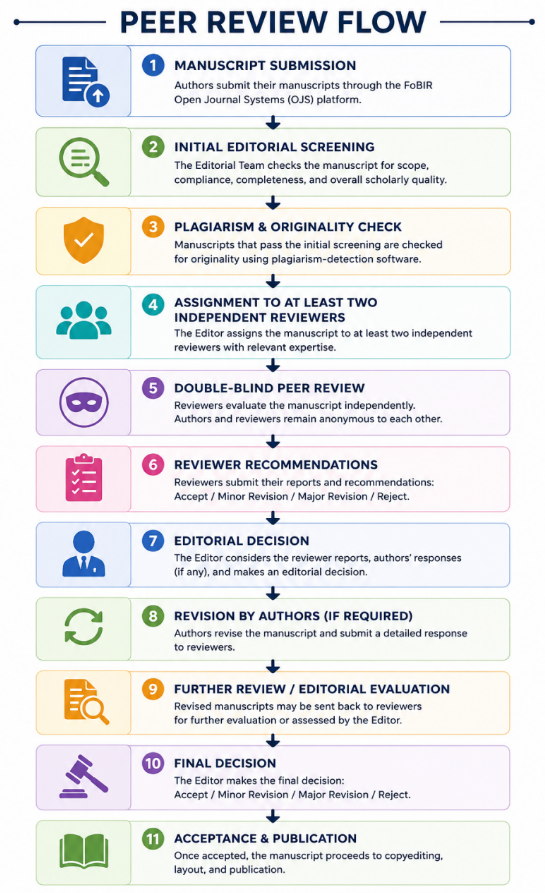
The editorial and peer-review process consists of the following stages:
1. Manuscript Submission
Authors submit their manuscripts through the FoBIR Open Journal Systems (OJS) platform.
The corresponding author is responsible for ensuring that the manuscript complies with the journal's Author Guidelines and that all required submission information and supporting documents have been provided.
2. Initial Editorial Screening
After submission, the manuscript undergoes an initial screening by the Editorial Team.
The screening evaluates:
-
Relevance to the Focus and Scope of FoBIR
-
Compliance with the Author Guidelines
-
Completeness of the manuscript
-
Overall scholarly quality
-
Clarity of the research objectives
-
Appropriateness of the research methodology
-
Potential theoretical and/or practical contribution
-
Compliance with publication ethics
Manuscripts that are clearly outside the journal's scope or do not meet minimum scholarly and editorial standards may be declined without external peer review (desk rejection).
3. Plagiarism and Originality Screening
Manuscripts that pass the initial editorial screening may undergo an originality check using appropriate plagiarism-detection software.
The Editorial Team evaluates similarity reports carefully and does not rely solely on a numerical similarity score. Particular attention is given to inappropriate text reproduction, unattributed material, duplicate publication, and other potential violations of publication ethics.
Manuscripts with serious originality or research-integrity concerns may be rejected or investigated further in accordance with the journal's Publication Ethics policy.
4. Reviewer Assignment
Manuscripts that successfully pass the initial screening are assigned to at least two independent reviewers with relevant expertise in the manuscript's subject area.
Reviewers are selected based on their:
-
Subject expertise
-
Academic and/or professional qualifications
-
Relevant research experience
-
Independence from the authors
-
Absence of significant conflicts of interest
FoBIR makes reasonable efforts to ensure that reviewers provide independent, objective, and constructive evaluations.
5. Double-Blind Peer Review
FoBIR employs a double-blind peer-review process.
During this process:
-
Reviewers do not know the identities of the authors.
-
Authors do not know the identities of the reviewers.
-
Review reports are treated as confidential.
-
Reviewers are expected to provide objective, constructive, and academically justified feedback.
Reviewers typically evaluate manuscripts based on:
-
Originality and significance
-
Relevance to FoBIR's Focus and Scope
-
Clarity of research objectives or questions
-
Quality of the theoretical or conceptual foundation
-
Appropriateness and rigor of the methodology
-
Quality of analysis and interpretation
-
Validity of findings and conclusions
-
Theoretical contribution
-
Managerial, practical, and/or policy implications
-
Quality and relevance of references
-
Overall clarity and organization of the manuscript
6. Reviewer Recommendations
After evaluating the manuscript, reviewers may recommend one of the following:
-
Accept
-
Minor Revision
-
Major Revision
-
Reject
Reviewer recommendations serve as important inputs to the editorial decision but do not automatically determine the final outcome.
7. Revision by Authors
When revisions are requested, authors should carefully address the comments and recommendations provided by the reviewers and editors.
Authors are generally expected to submit:
-
A revised manuscript; and
-
A detailed response to reviewers explaining how each comment has been addressed.
Where authors disagree with a reviewer recommendation, they should provide a clear and academically justified explanation.
Revised manuscripts may be returned to the original reviewers for further evaluation, particularly in cases involving major revisions.
8. Further Review
Depending on the extent and quality of the revisions, a manuscript may undergo more than one round of peer review.
Additional review may be required when:
-
Major methodological or theoretical concerns remain unresolved.
-
Substantial changes have been made to the manuscript.
-
Reviewers request further clarification.
-
The Editor determines that additional expert assessment is necessary.
9. Final Editorial Decision
The Editor-in-Chief and/or designated Editor makes the final publication decision after considering:
-
Reviewer reports
-
Authors' responses and revisions
-
Academic quality and originality
-
Methodological rigor
-
Theoretical and/or practical contribution
-
Compliance with journal policies and publication ethics
The final decision may be:
Accepted | Minor Revision | Major Revision | Rejected
The final decision regarding publication rests with the Editor and is not determined solely by reviewer recommendations.
10. Confidentiality and Conflict of Interest
Editors and reviewers must maintain the confidentiality of submitted manuscripts and must not use unpublished information obtained through the review process for personal or professional advantage.
Reviewers should decline a review invitation or inform the Editor when a potential conflict of interest could compromise—or reasonably appear to compromise—their independence and objectivity.
11. Editorial Independence
Editorial decisions are based on the scholarly merit, originality, relevance, methodological rigor, and contribution of submitted manuscripts.
Decisions are made independently of authors' institutional affiliations, nationality, personal background, or financial considerations.
Article Processing Charges (APCs), where applicable, do not influence editorial or peer-review decisions.